Unlike SEO, which has a mature tooling market (Ahrefs, Semrush, Screaming Frog), dedicated AEO tooling is a thin, early category — most of what's genuinely useful today is either a purpose-built checker for a specific AEO signal, an AEO-relevant feature bolted onto an existing SEO suite, or a manual technique that doesn't need a tool at all. Be skeptical of any platform claiming to be a comprehensive "AEO tool" — the category is too new for that to be fully true yet.
For the underlying strategy this tooling supports, see How to Structure Content for AI Search — the tools below help you check and execute that strategy, they don't replace it.
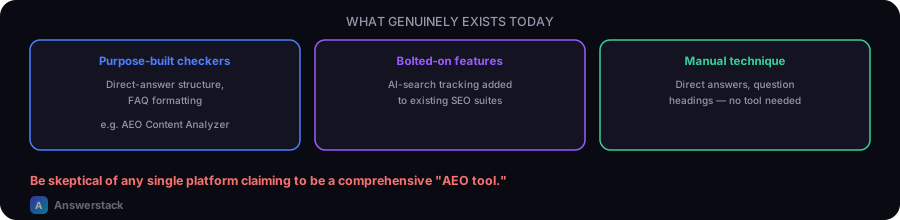
What genuinely exists today
Purpose-built AEO/content-structure checkers
Tools that specifically analyze whether content is structured for direct-answer extraction (clear question-answer patterns, scannable structure, FAQ formatting) — including our own AEO Content Analyzer, which checks structure and gives concrete, actionable feedback rather than a vague score.
AEO-relevant features inside existing SEO suites
Established SEO platforms have started adding AI-search-adjacent features (tracking AI Overview appearances, monitoring brand mentions in AI-generated answers) as additions to their existing product, not as standalone AEO products. These are worth using if you already subscribe to the suite for its core SEO features — not worth subscribing to a suite for this feature alone yet, since the AI-search tracking itself is still immature (see How to Measure AI Search Visibility for why).
Structured data validators
Schema markup validation tools (checking your JSON-LD is valid and matches visible page content) aren't AEO-specific, but structured data is part of the entity-clarity signal that helps AI systems attribute content correctly — see Entity SEO Explained.
What doesn't need a tool at all
- Writing a direct answer near the top of a section — this is an editorial practice, not something a tool does for you.
- Checking your own content against real AI search results — manually asking ChatGPT, Perplexity, and Google's AI Overview your target questions and seeing whether and how you're cited is free, direct, and currently more reliable than most automated tracking claims to be.
- Structuring FAQ sections and question-based headings — a content/editorial decision, not a tool output.
What to be skeptical of
- "AI visibility score" as a single number — given how immature and inconsistent AI search citation tracking is across platforms (see How to Measure AI Search Visibility), a single confident-sounding score from a tool should be treated as a rough directional signal, not a precise metric.
- Guaranteed citation or ranking claims — no tool can guarantee an AI system will cite you; anyone claiming this is overselling what's currently possible.
- Tools that only check keyword presence — AEO is about answer clarity and extractability, not keyword matching; a tool that scores you purely on keyword density is applying old-SEO logic to a different problem.
A practical toolkit for right now
- A content-structure checker (like the AEO Content Analyzer) for the editorial-structure signal.
- Manual spot-checks against real AI search tools for your top target questions — the most reliable signal available today.
- Schema/structured data validation as part of your existing technical SEO process, not a separate AEO-only step.
- Whatever AI-search tracking feature your existing SEO suite already includes, treated as directional, not precise.