Entity SEO is the practice of clearly identifying the people, organizations, products and concepts ("entities") referenced on your site, so search and AI systems can map them to a specific, unambiguous real-world thing rather than guessing from surrounding keywords.
Why entities matter more than keywords alone
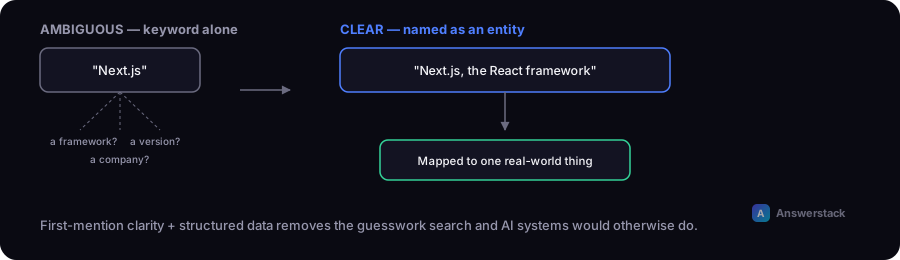
Search and AI systems increasingly reason in terms of entities and their relationships, not just matched keywords. A page that mentions "Next.js" gains more from clearly being about the Next.js framework (an unambiguous entity) than from repeating the word "Next.js" many times without clear context. Ambiguity — same word, multiple possible meanings — is the main problem entity SEO solves.
Practical entity SEO techniques
Be explicit on first mention
The first time you introduce a concept, name it precisely and, if relevant, disambiguate it: "Next.js, the React framework" rather than just "Next.js" with no context, especially on a page that might otherwise be ambiguous.
Use structured data accurately
Organization, Person, and Article schema (used correctly, matching visible content) give systems explicit entity information rather than requiring inference — see this site's own organization schema as an example of the pattern.
Keep author and organization info consistent
Use the same name, description, and details for your organization and named authors across your site (About page, article bylines, contact page). Inconsistency creates ambiguity about whether these are the same entity.
Link to canonical references where relevant
Linking a first mention of a well-known entity (a technology, a standard, a company) to an authoritative reference helps disambiguate which specific entity you mean.
Avoid vague pronoun-heavy writing
"It helps with that" across several sentences with unclear antecedents is hard for both humans and extraction systems to resolve to specific entities. Repeat the entity name when clarity matters more than variety.
A worked example
Ambiguous: "RAG makes chatbots better by using your own data. It's become popular because it solves accuracy problems."
Entity-clear: "Retrieval-augmented generation (RAG) is a chatbot architecture that retrieves relevant content from your own knowledge base and provides it to the language model as context before it generates a response. RAG chatbots are more accurate on business-specific questions than chatbots without retrieval, because the model is answering from real, provided content rather than general training knowledge."
The second version names the entity precisely, defines it once clearly, and keeps subsequent references unambiguous.
How this connects to GEO
Entity clarity is one of the core building blocks described in What Is GEO? — it's what lets a generative AI system confidently attribute a specific claim to a specific, well-defined concept or organization, which in turn makes your content more useful to cite accurately.