Structuring content for AI search means making each idea extractable on its own: clear question headings, a direct answer immediately after each one, and enough self-contained context that a paragraph makes sense without the rest of the article.
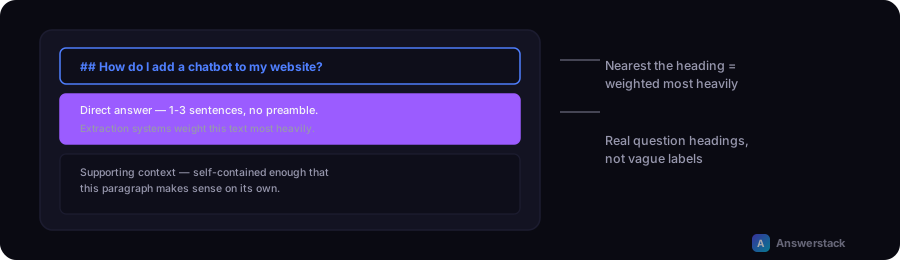
The structural checklist
1. Lead with a direct answer
For any question-shaped topic, put a 1–3 sentence direct answer immediately below the heading, before any preamble or context. Extraction systems weight the text nearest the heading most heavily.
2. Use real question headings
Write headings the way people actually ask the question ("How do I add a chatbot to my website?"), not vague labels ("Implementation"). This also improves standard SEO relevance matching.
3. Keep answer paragraphs self-contained
Avoid answers that only make sense with heavy prior context ("As mentioned above, this also applies here…"). Each section should be understandable if it were the only thing extracted.
4. Define terms precisely, once
The first time you introduce a term (AEO, RAG, Core Web Vitals), give a clean one-sentence definition before elaborating. This single sentence is often exactly what gets extracted or cited.
5. Use lists and tables for anything comparative or sequential
Numbered steps, comparison tables, and bulleted criteria are structurally easier to parse than the same information embedded in dense prose.
6. Make limitations explicit
State what your answer doesn't cover or where it might not apply. This is both more honest and more useful to a system trying to represent your content accurately — a confident-sounding answer without caveats is more likely to be misapplied.
7. Use clean semantic HTML
Proper heading hierarchy (H1 → H2 → H3, no skipped levels), real <table> markup for tabular data, and real list elements — not visually-styled divs pretending to be lists. See the Heading Analyzer to check your own pages.
An example, before and after
Before (buried answer):
When people ask about AEO, there's a lot to consider. The search landscape has changed a lot recently, and many factors go into how content performs. One important concept that's emerged is what's called answer engine optimization, which is essentially about...
After (direct, extractable):
AEO (answer engine optimization) is the practice of structuring content so answer-oriented search systems can extract and surface it directly.
The second version gives an extraction system — or a human skimmer — an immediate, usable answer.
What this does not mean
Structuring for extraction doesn't mean writing shallow content. Depth still matters — this structure is about where the direct answer lives, not about removing the explanation, examples, and nuance that follow it. The best-performing content pairs a clean direct answer with genuinely thorough follow-up detail.