SEO optimizes for ranking in a list of search results. AEO optimizes for being extracted as a direct answer (featured snippets, voice assistants). GEO optimizes for being cited or referenced by generative AI systems. They share a foundation but target different output formats.
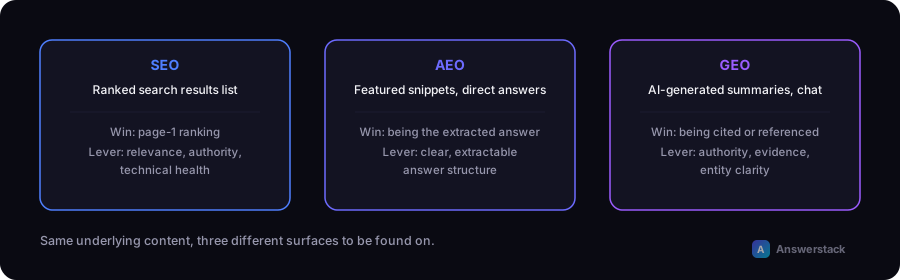
Quick comparison
| SEO | AEO | GEO | |
|---|---|---|---|
| Target surface | Ranked search results list | Featured snippets, voice assistants, answer boxes | AI chat assistants, generative search summaries |
| Success looks like | Ranking on page 1 for a query | Being the extracted/spoken answer | Being cited or referenced in an AI-generated response |
| Core lever | Relevance + authority + technical health | Clear, extractable answer structure | Authority, evidence, entity clarity, citability |
| Content shape | Comprehensive page covering a topic | Direct answer immediately after a question heading | Original data, clear sourcing, defined entities |
| Measurability | Rankings, clicks, impressions (Search Console) | Snippet ownership, voice results (harder to track) | Citation appearances (currently hardest to track) |
How they relate, not compete
These aren't three separate strategies — they're three lenses on the same underlying content:
- Strong SEO fundamentals (crawlability, topical authority, genuine usefulness) are the foundation all three need.
- AEO adds a structural layer on top: answer-first formatting, clear question headings, self-contained explanations.
- GEO adds an evidence and authority layer: original research, clear authorship, citations, and unambiguous entity information (see Entity SEO Explained).
A well-built article that ranks well, answers clearly, and cites its reasoning tends to perform across all three simultaneously.
A practical way to think about it
Ask three questions when writing or reviewing a piece of content:
- SEO: Does this page comprehensively and accurately cover what people searching this topic actually need?
- AEO: If someone needed one sentence pulled from this page as a direct answer, is there a clean one to pull?
- GEO: If an AI system were deciding whether to trust and cite this page, is there clear authorship, evidence, and specificity — or is it generic and unverifiable?
What none of them are
None of SEO, AEO, or GEO involve guaranteed outcomes. No one — including any tool, this site included — can promise a specific ranking, snippet placement, or AI citation. What you can control is the underlying quality, structure, and evidence in your content; the rest depends on factors outside any single site's control.