AI search engines (ChatGPT search, Perplexity, Google AI Overviews) cite sources they can extract a clear, direct, well-supported answer from — not necessarily the sources that rank highest traditionally. Getting cited is less about backlinks and more about structuring content so a model can confidently pull a specific claim and attribute it to you.
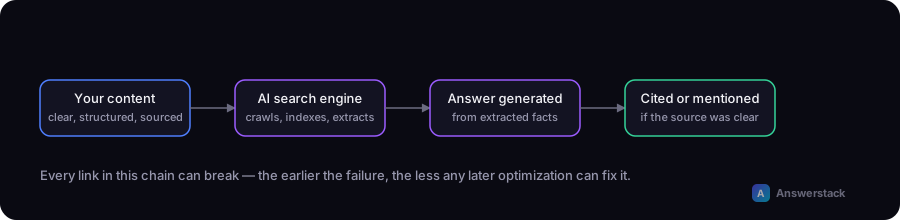
This pulls together three things covered separately elsewhere — see How to Structure Content for AI Search, Entity SEO Explained, and Topical Authority Explained — into one practical checklist.
What actually makes content citable
1. A direct, extractable answer near the top
If a model has to infer your position from three paragraphs of hedging, it's less likely to cite you confidently — and more likely to cite a source that states the answer plainly. Open sections with a direct answer, then explain and qualify below it (the same pattern used throughout this site).
2. Specific claims, not vague generalizations
"AI automation can save time" is not citable — it's not a claim, it's a category. "Support ticket triage automation typically cuts first-response time by X" is citable, assuming it's actually true and you can back it up. Specificity is what makes a sentence quotable.
3. Clear entity identity
A model needs to know who's making the claim to attribute it. Consistent naming, a clear author/organization signal, and structured data (Organization schema) all help a model resolve "who said this" — see Entity SEO Explained.
4. Topical depth, not a single isolated page
A model is more likely to trust and cite a source that demonstrates depth across a topic — multiple connected pages covering a subject thoroughly — over a single standalone page with no supporting context. This is the same topical-cluster structure that helps traditional SEO; see Topical Authority Explained.
5. Content that's actually current
AI search systems weight recency for time-sensitive topics. A page with an outdated updated date and stale specifics (old pricing, deprecated tools) is a weaker citation candidate than a maintained one, even if the original version once ranked well.
What doesn't matter as much here as it does for traditional SEO
- Raw backlink count — citation in AI search answers correlates more with content clarity and extractability than with link volume, though authority signals aren't irrelevant entirely.
- Exact-match keyword density — models work with meaning, not string matching; natural, clear language outperforms keyword-stuffed phrasing for citability.
- Page length for its own sake — a long page with a buried, hedged answer is less citable than a shorter page with a clear one.
A practical checklist
- Does the page answer its core question directly in the first few sentences of the relevant section?
- Are claims specific and falsifiable, not vague?
- Is the source (you/your organization) clearly and consistently identified, with Organization schema in place?
- Does this page sit inside a cluster of related, interlinked content on the same topic — not standing alone?
- Is the content actually current, with stale specifics updated?