A restaurant chatbot's realistic value is answering the repetitive questions that interrupt staff during service — hours, whether a dish contains a specific allergen, parking, whether they take reservations — freeing phone and counter staff for what actually needs a person. Full order-taking or reservation-booking through a chatbot works only when it's properly connected to your actual live systems, not a bolt-on that can promise something the restaurant can't deliver.
For the general framework this applies, see AI Chatbots for Small Businesses.
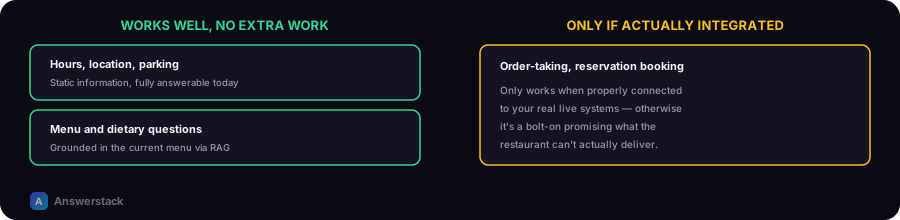
What genuinely works well
- Hours, location, parking, and general logistics — the most repetitive category of questions, fully answerable from static information.
- Menu and dietary questions — "Is the X gluten-free," "what's in the Y" — grounded in your actual current menu (see RAG Chatbots Explained for how this stays accurate), not a static script that goes stale when the menu changes.
- Reservation inquiries that route to your actual booking system — the bot should link to or hand off to your real reservation platform, not attempt to manage bookings itself unless it's directly integrated with one.
- Private event / catering inquiry capture — qualifying interest (date, headcount, budget range) before a human follows up, similar in spirit to AI Chatbot Scripts and Flows That Actually Convert Leads.
What to be careful with
- Never let the bot guess about allergens or ingredients. A wrong answer about a specific allergen is a real safety issue, not just a bad customer experience — ground this specifically in your actual, current menu data, and set a low-confidence fallback that routes to a human rather than guessing.
- Don't promise a reservation the bot didn't actually confirm. If reservations aren't live-integrated, the bot should clearly say so and direct to a phone call or booking link, not imply the table is held.
- Keep menu content current. A chatbot answering from a stale, cached menu is worse than no chatbot — this needs the same "keep the knowledge base current" discipline as any RAG-grounded bot.
A realistic starting scope
- Hours, location, and logistics — zero risk, immediate value.
- Menu and dietary Q&A, grounded in the actual current menu.
- Reservation and event inquiry routing — capture and hand off, don't attempt full booking management unless properly integrated.
- Expand only once the above is working reliably and staff have validated it's answering correctly.