Chatbot flows that convert ask one qualifying question before offering anything, then tailor the next step to the answer. Flows that don't convert open with a menu of options, ask for contact details before providing any value, or try to sound human instead of being clearly useful.
This assumes you already have a chatbot live or in progress — for platform selection, see Best AI Chatbot Platforms: How to Choose. This article is about what the conversation itself should say.
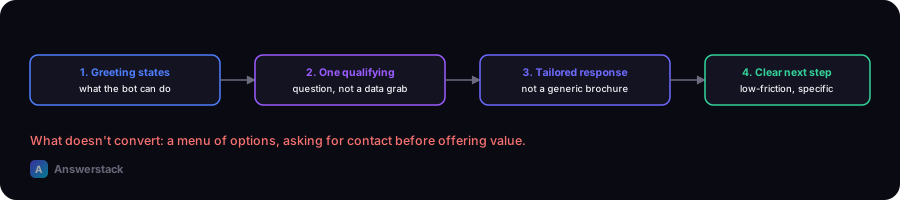
The anatomy of a flow that converts
- Greeting that states what the bot can do — not "Hi! How can I help you today?" (too open-ended, forces the visitor to write a summary of their own problem), but "I can help you find the right plan, check pricing, or connect you with the team — which is closest?"
- One qualifying question, chosen to route the visitor to the most relevant next step — not to collect data for its own sake.
- A tailored response based on that single answer, not a generic brochure reply.
- A clear, low-friction next step — book a call, get a specific answer, or a "want us to follow up?" prompt for contact capture, offered after the visitor has gotten something useful, not before.
- A visible handoff to a human when the conversation goes beyond what the bot can usefully answer — see AI Chatbot vs Live Chat for how to design that handoff.
Qualifying questions by business type
| Business type | Qualifying question |
|---|---|
| B2B SaaS | "What's the main thing you're trying to solve — [problem A], [problem B], or something else?" |
| Local service business | "Is this for [service type 1] or [service type 2]?" |
| Agency / consultancy | "Are you exploring options, or ready to talk about a specific project?" |
| E-commerce | "Are you looking for something specific, or browsing?" |
The pattern in each case: one question, a small number of answers, each answer leading somewhere genuinely different — not the same generic response regardless of what's picked.
What to avoid
- A wall of menu options up front. More than 3-4 choices at the greeting increases drop-off before the visitor even engages.
- Asking for email or phone before providing value. Answer the question or provide the resource first; ask for contact info once the visitor has a reason to want a follow-up.
- Pretending to be human. Disclosing it's an AI assistant, clearly, builds more trust than an uncanny attempt to pass as a person — and most visitors will test it within the first message anyway.
- No escalation path. If the bot can't help, it should say so and offer a human option immediately, not loop the visitor through unrelated menu options.
- Optimizing for conversation count instead of qualified conversations. A bot that talks to more people but routes fewer of them correctly is not an improvement — see the measurement section below.
A simple flow example
Greeting: "I can help you check pricing, see if we cover your area, or get you booked for a quote — which one?"
If "check pricing": Bot asks 1-2 clarifying questions (property size, service type), gives a real range or exact number, then offers: "Want this sent to your email, or would you rather book a 10-minute call to get an exact quote?"
If the bot can't answer confidently: "That's a good question for our team directly — want me to connect you, or leave your email and we'll follow up today?"
Every branch ends in either a real answer or a clear, low-friction next step — never a dead end.
Measuring whether it's actually working
Track qualified conversation rate, not raw conversation count: of all conversations, what percentage reach a real next step (booked call, email captured, question fully answered) versus abandoning mid-flow or looping without resolution. A bot with fewer total conversations but a higher qualified rate is outperforming one with more traffic and a lower rate. Use the AI Chatbot Cost Calculator to weigh the cost per conversation against what a qualified lead is actually worth to the business.