Topical authority is the degree to which a website is recognized — by search engines, AI systems, and users — as a comprehensive, trustworthy source on a specific subject area, built by covering that subject in depth over time rather than publishing isolated articles.
Why topical authority matters for GEO
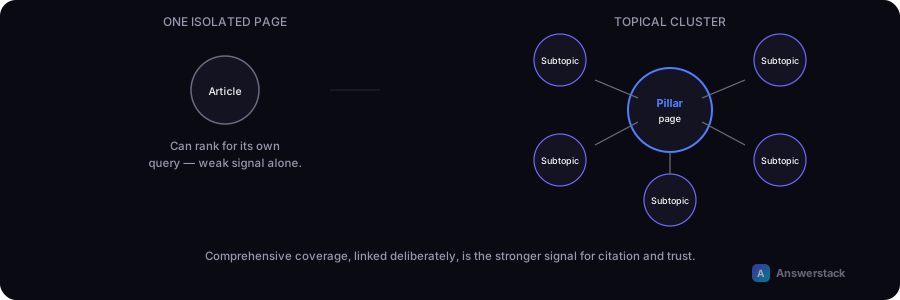
A single well-written article can rank for its specific query. But when a generative AI system is deciding which source to draw from or cite, a site that demonstrably covers the surrounding topic area in depth is a stronger, more trustworthy signal than an isolated page with no supporting context — even if that isolated page is well-written.
How topical authority is built
1. Comprehensive cluster coverage
Cover a topic's full range of subtopics, not just the highest-search-volume keyword. For example, a genuine AI chatbot cluster covers website chatbots, customer support use cases, lead generation use cases, RAG architecture, security, and cost — not just "what is an AI chatbot."
2. Internal linking that reflects real relationships
Pillar and cluster pages linked deliberately (see How Internal Linking Works) make the topical structure explicit to both search engines and readers.
3. Consistency over time
Authority accumulates as a topic area is maintained and expanded, not just published once. Outdated, unmaintained clusters lose authority relative to actively maintained ones.
4. Depth over volume
Ten thorough, well-linked articles covering a topic's real subtopics build more authority than fifty shallow, repetitive ones. Thin content dilutes rather than strengthens a cluster.
A simple self-check
For any topic area you want authority in, ask:
- Could a reader who only used this site get a genuinely complete understanding of the topic, including edge cases and limitations?
- Are the articles in this cluster linked to each other in a way that reflects how the subtopics actually relate?
- Is anything in the cluster outdated in a way that would mislead a current reader?
If the honest answer to any of these is "no," that's a gap in topical authority before it's a gap in article count.
Topical authority vs. domain authority
These are often conflated but differ: domain authority is a general measure of overall site trust/strength; topical authority is specific to a subject area. A large, generally authoritative site can still lack topical authority in a niche it's never seriously covered — and a smaller, focused site can out-perform it within that specific niche by being genuinely more comprehensive there.