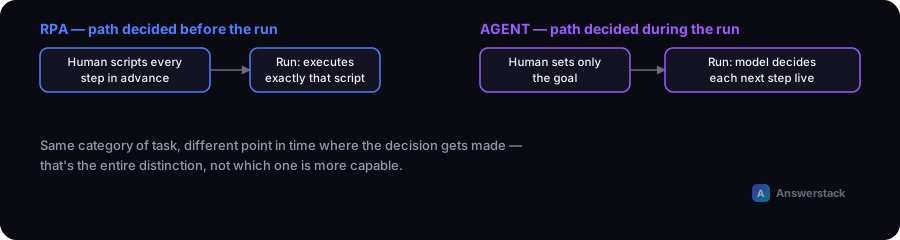
RPA executes a sequence of system interactions someone scripted in advance — the path is fixed. An AI agent is given a goal and a set of tools, and decides at runtime which tools to call, in what order, based on what it finds along the way. The distinction is about who determines the path (a human, in advance, for RPA; the model, at runtime, for an agent) — not simply which one is "smarter."
This is the agent-specific version of the broader comparison in AI Automation vs RPA — read that first if you haven't decided whether you need agent-level autonomy at all, since most business processes don't.
The core distinction
| RPA | AI agent | |
|---|---|---|
| Who defines the path | A human, in advance (recorded/scripted) | The model, at runtime |
| Predictability | High — identical steps every run | Lower — path can vary by input |
| What it can handle | Structured, repetitive UI/system interaction | Open-ended tasks with multiple valid approaches |
| Failure mode | Breaks when the underlying interface changes | Can take an unexpected or excessive number of steps |
| Typical task | Move data between two specific systems, the same way every time | Research a topic, troubleshoot across multiple data sources, complete a task with an unknown number of steps |
Why this distinction matters more than "which is more advanced"
RPA isn't a lesser version of an AI agent — it's the right tool when a process is genuinely fixed and repeatable, and its rigidity is a feature: you get the exact same result every time, which matters for compliance-sensitive or high-volume structured tasks. An AI agent's flexibility is valuable specifically when the task doesn't have one correct fixed path — but that same flexibility means less predictability and, per AI Agents vs Automation, real guardrails (step limits, human checkpoints) are needed to keep it from going wrong in ways a fixed RPA script structurally can't.
A simple test for which you need
- Can you write down the exact steps in advance, and will they stay the same every time? → RPA is the right fit — simpler, cheaper, more predictable.
- Does the number and order of steps genuinely depend on what's discovered along the way? → That's agent territory, and worth the added complexity only if the flexibility is actually needed.
- Is it a fixed sequence of steps, but one of the steps requires understanding unstructured input (not multi-step planning)? → That's neither — it's AI automation, a fixed workflow with an AI step inside it. See AI Automation vs RPA.
Where they can work together
An agent can call an RPA-driven process as one of its tools — for example, an agent researching a customer account might invoke a scripted RPA lookup against a legacy system as one step in a longer, dynamically-planned sequence. The RPA piece stays exactly as rigid and predictable as it needs to be; the agent layer only adds flexibility where the overall task actually requires it.