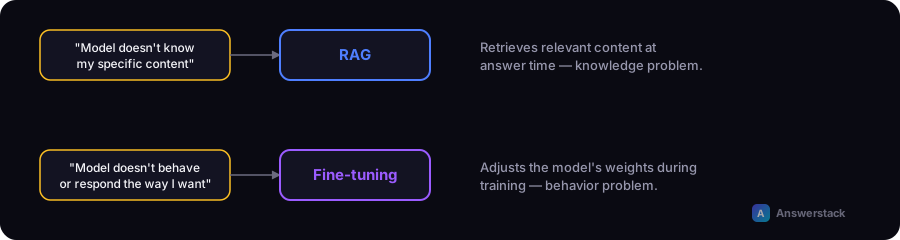
RAG (retrieval-augmented generation) and fine-tuning solve different problems and aren't substitutes for each other: RAG gives a model access to specific, current knowledge it wasn't trained on; fine-tuning changes how a model behaves, responds, or formats output. Most "should I use RAG or fine-tuning" questions are actually knowledge problems, which means the answer is RAG.
If you haven't read how the retrieval pipeline itself works, start with RAG Chatbots Explained — this article is about which approach to reach for, not the mechanics.
What each one actually does
| RAG | Fine-tuning | |
|---|---|---|
| Solves | The model doesn't know your specific content | The model doesn't behave/respond the way you want |
| How | Retrieves relevant content at query time, adds it to the prompt | Retrains the model's weights on example input/output pairs |
| Content freshness | Update the knowledge base, answers update immediately | Requires re-training to reflect new information |
| Cost to change | Low — edit or re-index content | Higher — requires a new training run |
| Typical use | "Answer questions using our docs/policies/product info" | "Always respond in this tone," "always output this JSON structure," "handle this narrow task in this specific style" |
Why "our chatbot gives wrong answers" is almost always a RAG problem
If a chatbot is confidently wrong about your refund policy, pricing, or product details, the model doesn't have that information — no amount of fine-tuning teaches a model your specific, frequently-changing business facts in a durable way. Fine-tuning a model on today's pricing page means tomorrow's price change requires a new training run. This is a knowledge-freshness problem, and RAG is architected specifically to solve it — see the retrieval pipeline in RAG Chatbots Explained.
When fine-tuning is actually the right tool
Fine-tuning earns its cost for behavior and format problems that persist across all queries, not knowledge gaps:
- Enforcing a specific, consistent output structure (a fixed JSON schema, a particular formatting convention) more reliably than prompting alone achieves
- Teaching a narrow, repetitive task pattern (a specific classification scheme, a specialized extraction format) where prompting produces inconsistent results
- Adjusting tone/style consistently across a high-volume use case where prompt instructions alone drift over long conversations
Notice none of these are "the model doesn't know X fact" — they're all "the model doesn't consistently behave in Y way."
The combination that most production systems actually use
RAG and fine-tuning aren't mutually exclusive. A common production pattern: RAG handles grounding the model in current, specific content, while lightweight prompting (not even fine-tuning) handles tone and format — fine-tuning is reserved for cases where prompting demonstrably fails to produce consistent behavior at scale. Reach for fine-tuning only after prompting has been genuinely tried and shown insufficient, since it's the more expensive, slower-to-iterate option of the two.
A simple decision path
- Is the problem "the model doesn't know something"? → RAG.
- Is the problem "the model knows the answer but formats/behaves inconsistently"? → Try better prompting first.
- Does the behavior problem persist after solid prompting, at real scale? → Consider fine-tuning.
- Is it both? → Use RAG for grounding, and only add fine-tuning if prompting the RAG-augmented model still doesn't produce consistent behavior.