A genuinely free AI chatbot for a website exists in two forms: a free tier of a commercial no-code platform (capped conversations, limited knowledge base size, usually provider branding) or a self-hosted open-source project (no usage cap, but you run the infrastructure and pay for the underlying model API calls yourself). Neither is "free" in the sense of zero cost and zero limits — knowing which trade-off you're accepting matters more than the word "free" itself.
For the fuller platform-selection framework, see Best AI Chatbot Platforms: How to Choose. This article is specifically about what the free option gets you and where it runs out.
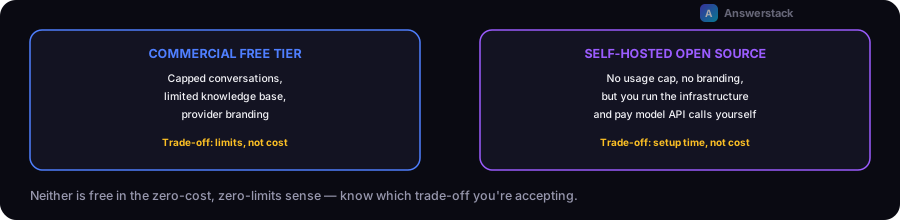
What a free tier of a commercial platform typically includes
- A capped number of conversations or messages per month
- A limited knowledge base size (page count or document size ceiling)
- Provider branding on the widget ("Powered by X"), removable only on paid tiers
- Basic customization — enough to match a color scheme, not a fully custom UI
This is genuinely useful for validating whether a chatbot helps before committing to a paid plan — the honest use case for a free tier is a pilot, not a permanent production setup once you have real, meaningful traffic.
What self-hosted open-source gets you instead
Running an open-source chatbot framework yourself removes the conversation cap and branding, but shifts the cost elsewhere:
- You pay for model API usage directly — no markup from a platform, but also no free allowance beyond what the model provider itself offers
- You handle hosting and maintenance — deployment, updates, uptime become your responsibility
- Setup requires more technical capacity — this isn't a no-code, five-minute setup
This is the right trade-off for a team with development capacity who wants full control and no per-conversation platform fee — see Building APIs for AI Applications for the implementation pattern.
Where free tiers actually break down
- Traffic outgrowing the conversation cap — the moment you exceed the free tier's monthly limit, conversations either stop working or get blocked until the next billing cycle, which is a worse outcome than not having a chatbot at all if it happens unexpectedly.
- Knowledge base too large for the free tier's limit — a genuinely useful support chatbot grounded in your full documentation (see RAG Chatbots Explained) often exceeds what free tiers allow to index.
- Needing to remove platform branding — for a customer-facing product, unbranded is often a real requirement, not a preference, which pushes you to a paid tier regardless of usage volume.
A realistic decision path
- Start on a free tier if you're validating whether a chatbot helps at all — don't build custom infrastructure before confirming the use case works for your actual visitors.
- Watch your usage against the free tier's actual limits, not just "is it working today" — know in advance what happens when you hit the cap.
- Move to a paid tier or self-hosted option once you have real, sustained usage — at that point the free tier's limitations (branding, caps) usually outweigh the cost of a modest paid plan.
- Consider self-hosted specifically if you have development capacity and want to avoid per-conversation platform fees long-term — not as a default starting point, since it trades platform cost for setup/maintenance time.