A chatbot's job is conversation: answering questions, following a scripted or RAG-grounded flow, and handing off to a human when it can't help. An AI agent's job is task completion: it's given a goal and a set of tools, and it plans and executes multiple steps — which may or may not involve talking to anyone — to reach it. Most businesses asking "chatbot or agent?" actually need a chatbot; the word "agent" gets used loosely in marketing for both.
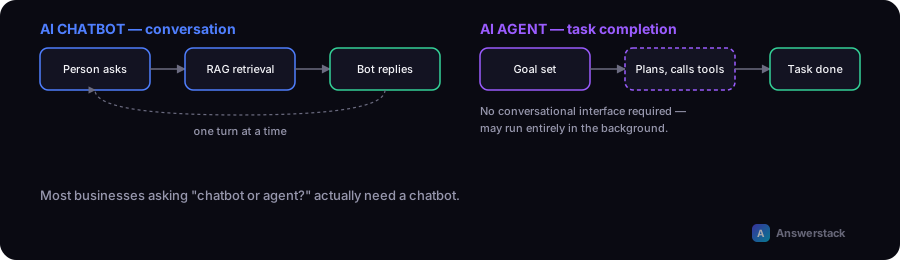
The core distinction
| AI chatbot | AI agent | |
|---|---|---|
| Primary job | Hold a conversation, answer questions | Complete a multi-step task toward a goal |
| Interface | Usually a chat widget, talking to a person | May have no conversational interface at all |
| How it works | Retrieves relevant content (RAG), responds in a turn | Plans a sequence of tool calls, executes them, checks progress |
| Output | A conversational reply | A completed task, a result, or a status |
| Typical use | Support Q&A, lead qualification, FAQ answering | Research tasks, data processing pipelines, multi-step workflows |
For the deeper technical version of this same distinction applied to backend workflows rather than chat, see AI Agents vs Automation.
Why the terms get blurred
Product marketing calls almost anything with an LLM behind it an "AI agent" now, including plain chatbots. The useful technical distinction is about autonomy over steps: a chatbot's "step" is generating one reply to one message — it doesn't plan ahead or call multiple tools in sequence to reach a goal. An agent might take five different actions, in an order it decides at runtime, before returning any output at all. A support chatbot that retrieves a doc and replies is not, by this definition, an agent — even if it's marketed as one.
A simple test: does it hold a conversation, or complete a task?
- "Answer visitor questions about our pricing and features" → chatbot. It's a conversational Q&A job with a bounded scope.
- "Research a company and produce a qualification report before a sales call" → agent. It's a multi-step task with no inherent conversational structure, even if the output eventually gets summarized in a message.
- "Let customers check order status and request a refund" → mostly chatbot, with a scripted sub-flow, not open-ended agent behavior — the steps (check order, check refund eligibility, process) are largely predictable and don't need runtime planning.
When you need both
A chatbot interface backed by agent-like task execution is common: the visitor has a conversation (chatbot layer), and behind the scenes, a bounded, constrained task gets executed (agent-like planning) to fulfill part of the request — see How to Build an AI Agent for the guardrails that make this safe (step limits, human review checkpoints). The conversational layer and the task-execution layer are different concerns, even when they show up in the same product.
Which one should you actually build first?
For most small businesses, start with a chatbot — see Best AI Chatbot Platforms: How to Choose. It's lower-risk, easier to evaluate, and covers the majority of real use cases (support deflection, lead qualification, FAQ answering). Reach for agent-style task execution only once you have a genuinely multi-step, open-ended task that a scripted flow can't handle — see AI Agents vs Automation for that decision in more depth.