AI chatbot costs come from three sources: usage-based model API costs (the largest variable component), platform or hosting fees (often a flat monthly rate), and setup/maintenance time. Model cost scales directly with conversation volume and message length, which is why it's the component most worth understanding in detail.
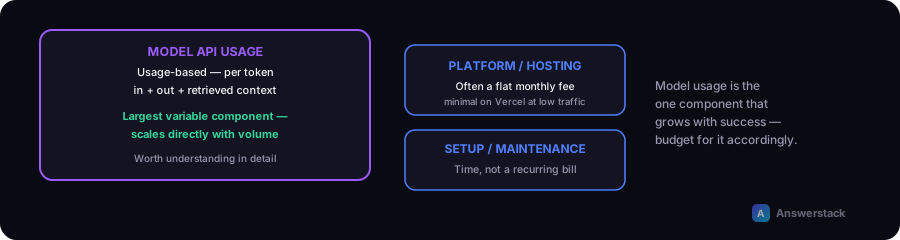
The three cost components
1. Model API usage (usage-based)
Charged per token (roughly, per chunk of text) processed — both what the user sends and what the model generates, plus any retrieved context inserted for grounding (see RAG Chatbots Explained). This is the component that scales directly with your traffic and conversation depth.
2. Platform or hosting fees (often fixed)
No-code chatbot platforms typically charge a flat monthly subscription, sometimes with usage tiers. A custom build instead has hosting costs (usually minimal on a platform like Vercel's free tier at low-to-moderate traffic).
3. Setup and maintenance (time, not direct cost)
Preparing the knowledge base, configuring escalation rules, and reviewing real conversations to improve accuracy — this is often the most underestimated cost category, even though it isn't a line item on a bill.
What drives model cost up or down
| Factor | Effect on cost |
|---|---|
| More conversations | Scales cost roughly linearly |
| Longer conversations (more back-and-forth) | More messages per conversation = more cost per conversation |
| Larger retrieved context (RAG) | More tokens per request = higher cost per message |
| More capable/expensive model tier | Higher per-token price |
| Verbose system prompts/instructions | Sent with every request — adds up at volume |
A rough way to estimate your own cost
- Estimate monthly conversations:
visitors × % who engage with the chatbot - Estimate messages per conversation (both user and assistant turns)
- Estimate tokens per message (question + retrieved context + answer combined)
- Multiply by your model tier's price per 1,000 tokens
- Add any flat platform fee
Use the AI Chatbot Cost Calculator to run this with your own numbers rather than by hand.
How to keep costs predictable
- Cap conversation length — after a set number of turns, either resolve or escalate, rather than letting conversations run indefinitely.
- Trim conversation history sent to the model — send the last N turns plus a summary rather than the entire history on every request.
- Right-size the model tier — many classification and simple-answer tasks don't need your most expensive model option.
- Set a spend alert with your model provider so a traffic spike or abuse doesn't produce a surprise bill — see AI Chatbot Security for abuse mitigation.
- Cache or shortcut common questions where a fixed answer is acceptable, rather than calling the model for identical repeated questions.
A realistic expectation
For most small-to-mid traffic sites, model API cost for a chatbot is a modest, usage-based line item — often smaller than the platform subscription fee at low volume, and worth monitoring (not necessarily worrying about) as traffic grows. The bigger cost driver in most real deployments is setup and ongoing knowledge-base maintenance time, not the API bill.