Model quality benchmarks matter less than four practical factors for most production applications: latency under real load, cost predictability at your actual volume, rate limits relative to your traffic pattern, and data handling policies for what you're sending. A slightly "smarter" model that's slow, expensive at scale, or rate-limited into unreliability loses to a "good enough" model that isn't.
This assumes you're building the API layer already — see Building APIs for AI Applications for the implementation pattern once you've picked a provider.
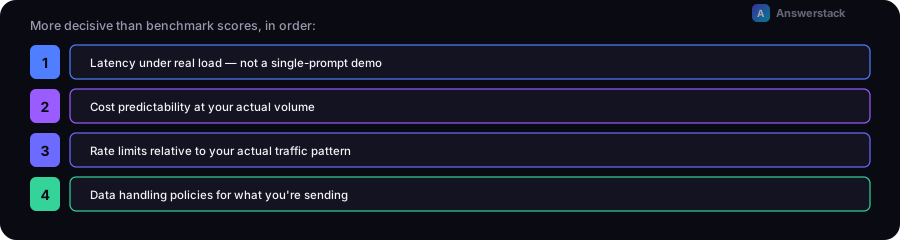
The factors that actually decide this, in order
1. Latency under real conditions, not a demo
Test with realistic input length and realistic concurrent load, not a single short prompt in a playground. A model that responds in 800ms for one request can behave very differently under 20 concurrent requests. If your feature is user-facing and synchronous (a chat reply, not a background job), latency variance under load matters more than the average case.
2. Cost predictability at your actual volume
Run your expected monthly volume through pricing, not a single-request estimate — token costs compound differently than they first appear, especially with longer context windows or conversation history. Use the AI Automation ROI Calculator or AI Chatbot Cost Calculator with your actual numbers, not round estimates.
3. Rate limits relative to your traffic pattern
A generous monthly quota doesn't help if your traffic spikes (a marketing push, a viral moment) hit a per-minute rate limit. Check both the aggregate limit and the burst/per-minute limit against your actual traffic shape, not just average volume.
4. Data handling and retention policy
If you're sending customer data, check explicitly whether the provider trains on your input by default, what retention period applies, and whether there's a data processing agreement available if you need one for compliance. This is a contractual/policy question, not a technical one — read the actual terms, not marketing copy.
What matters less than it seems
- Benchmark leaderboard position — benchmarks measure specific capabilities that may not map to your actual task; a model that's marginally behind on a general benchmark can outperform on your specific use case (classification, extraction, a narrow domain).
- Largest context window available — a bigger context window you don't need adds cost and latency without benefit; size this to your actual input length, not the maximum on offer.
- Newest model release — new models sometimes have less production track record and can have rougher edges (rate limit maturity, documentation gaps) than an established prior version.
A practical evaluation approach
- Define your actual task narrowly — not "which model is best" but "which model handles this specific classification/generation/extraction task well, on inputs like mine."
- Test 2-3 candidates against a real evaluation set — a set of representative inputs with known-good outputs, not a handful of ad-hoc prompts.
- Measure latency and cost on that same set, under conditions close to production (concurrent requests, realistic input length).
- Check rate limits and data policy against your actual requirements before committing.
- Build an abstraction layer (see Building APIs for AI Applications) so switching providers later — because pricing changed, a model was deprecated, or a better fit emerged — doesn't require rewriting your application logic.
A common mistake
Picking a provider based on a single well-known benchmark or a colleague's recommendation, without testing against your own representative inputs. Model performance varies meaningfully by task type — the model that's best at creative writing benchmarks isn't automatically best at structured data extraction from your specific document format.