AI search systems generally work in two stages: retrieval (finding relevant, credible content related to the query) and generation (synthesizing that content into a direct, readable answer, sometimes with citations). Understanding both stages explains what GEO can and can't influence.
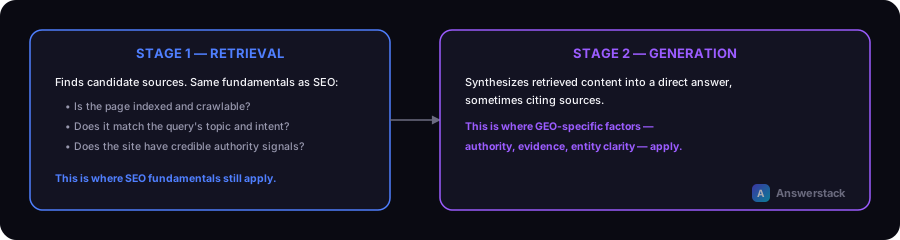
Stage 1: Retrieval
Before generating an answer, most AI search systems retrieve a set of candidate sources — through a search index, a live web search, or a pre-built knowledge base. This stage is influenced by many of the same fundamentals as traditional SEO:
- Is the page indexed and crawlable at all?
- Does it match the query's topic and intent clearly?
- Does the site have enough general authority/trust signals to be considered a credible source?
If your content isn't retrieved in this stage, it has no chance of appearing in the generated answer — which is why Technical SEO Explained fundamentals still matter for GEO.
Stage 2: Generation
Once candidate sources are retrieved, the system synthesizes an answer, drawing on the content it retrieved. This is where GEO-specific factors matter most:
- Clarity — is the relevant information stated plainly, or buried in ambiguous phrasing?
- Specificity — does the content give a concrete, useful answer, or vague generalities?
- Consistency across sources — if your content contradicts other credible sources on a factual point, it's less likely to be relied upon.
- Citability — some systems show source links; content that's clearly attributable to a specific, credible source is more useful to cite than an unattributed page.
Why this two-stage model matters practically
It means GEO work splits into two different jobs:
- Getting retrieved at all — this is largely classic SEO and technical health. No amount of clever structuring helps content that was never retrieved as a candidate.
- Being a good citation once retrieved — this is where clarity, evidence, authorship, and structure (the practices covered in What Is GEO?) make the difference.
What varies between systems
Different AI search and assistant products differ in:
- Whether they show citations/sources at all
- How many sources they draw from per answer
- Whether they favor recency, authority, or specific content types
- How frequently their retrieval index updates
Because of this variation, there's no single universal GEO checklist that guarantees results across every system — the fundamentals in this article apply broadly, but outcomes will differ by platform and change over time as these systems evolve.
A common misunderstanding
AI search doesn't "read the whole internet live" for every query in most implementations — it typically retrieves from an index or a bounded search step, similar in spirit to traditional search, then generates from what was retrieved. This is why indexing and crawlability remain foundational, not obsolete, in an AI-search world.