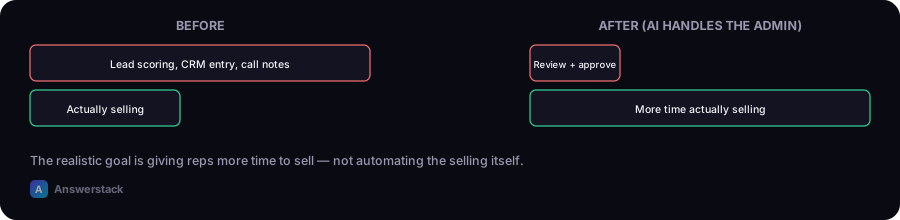
AI automation's highest-value role in sales is handling the unglamorous administrative work around selling — lead scoring, CRM data entry, call summaries, follow-up drafting — not replacing the actual sales conversation. The realistic goal is giving reps more time to sell, not automating the selling itself.
For the lead-qualification-chatbot version of this (capturing and qualifying inbound interest on a website), see AI Chatbot Scripts and Flows That Actually Convert Leads. This article covers the automation layer around the rest of the sales process.
Where AI automation genuinely helps
Lead scoring and routing
Automatically scoring inbound leads against your ICP criteria (company size signals, stated need, engagement level) and routing high-value leads to the right rep faster than manual review — see AI Workflow Patterns for the parallel-processing pattern this typically uses.
CRM data entry
Automatically logging call notes, extracting action items, and updating deal stages from call transcripts or emails removes one of the most consistently disliked parts of a sales rep's job — and CRM data quality usually improves as a side effect, since it stops depending on reps remembering to log things manually.
Call and meeting summaries
Auto-generating a structured summary and next steps from a sales call, pushed into the CRM automatically, saves the 10-15 minutes of manual note-writing that typically follows every call — see the same pattern in 5 AI Workflow Templates You Can Copy.
Follow-up drafting
Drafting a follow-up email based on the call summary and next steps, for the rep to review and send — not sent automatically, since sales follow-ups benefit from a rep's personal judgment about tone and relationship context in a way a fully automated send doesn't reliably replicate.
Where it doesn't replace the human
- The actual sales conversation — building trust, reading a prospect's real concerns, and handling objections in real time remain fundamentally human skills that current AI automation doesn't reliably replace.
- Complex or high-value deal strategy — deciding how to position a deal, when to involve leadership, or how to structure a custom offer requires judgment specific to the relationship and deal context.
- Final follow-up tone and send decisions — even a well-drafted follow-up benefits from a rep's read on the specific relationship before it goes out.
A practical starting approach
- Start with call/meeting summarization and CRM logging — bounded, low-risk, immediate time savings, and it improves data quality as a side effect.
- Add lead scoring next, using the AI Automation ROI Calculator to check the setup cost against realistic time saved at your lead volume.
- Add follow-up drafting once the above is working reliably — keep a human review-and-send step.
- Resist the urge to automate the actual conversation or complex deal judgment calls — this is where automation reliably underperforms a good rep.