Search intent is the underlying goal behind a search query — what the searcher actually wants to accomplish. Content that matches the wrong intent for a keyword rarely ranks well, no matter how well-optimized it otherwise is.
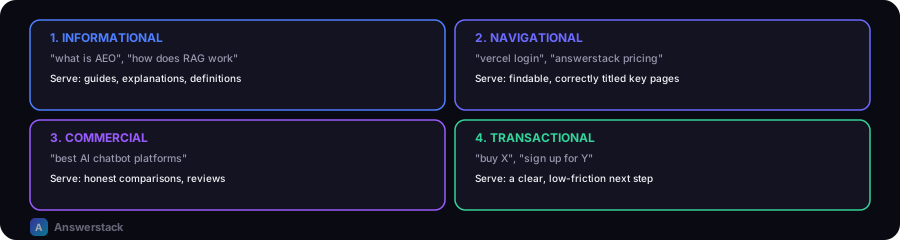
The four types of search intent
1. Informational
The searcher wants to learn something. "what is AEO", "how does RAG work". Best served by clear explanations, guides, and definitions — like this article.
2. Navigational
The searcher wants to reach a specific site or page. "vercel login", "answerstack pricing". Best served by making sure your own site's key pages (login, pricing, contact) are easy to find and correctly titled.
3. Commercial investigation
The searcher is comparing options before deciding. "best AI chatbot platforms", "chatbase vs intercom". Best served by honest comparisons and reviews — see Comparisons.
4. Transactional
The searcher is ready to act. "buy [product]", "[service] pricing". Best served by clear pricing/service pages with an obvious next step.
Why matching intent matters more than keyword density
Search engines learn intent from user behavior at scale — if searchers for a query consistently click on and stay on comparison articles, product pages, or explainer guides, that becomes the dominant intent for that query. Writing a long, keyword-optimized explainer for a query where searchers actually want a comparison table will underperform a shorter, correctly-matched page.
How to identify intent for a keyword
- Search the term yourself and look at what's actually ranking — articles, product pages, comparisons, videos, forums.
- Read the top 5 results and note the format, not just the topic — are they guides, listicles, tools, product pages?
- Check for mixed intent — some queries return a blend (e.g. "AI chatbot" might show both explainer articles and product pages), which signals you have flexibility, or that intent varies by searcher.
Matching content format to intent
| Intent | Content format that tends to win |
|---|---|
| Informational | Clear guide with a direct answer up front, then depth |
| Navigational | Well-titled, easy-to-find core pages on your own site |
| Commercial investigation | Honest comparison with pros/cons, tested where possible |
| Transactional | Direct pricing/service page, minimal friction to convert |
A common mistake
Writing a single article trying to serve all four intents for a broad topic usually serves none of them well. It's usually better to split into a cluster: one informational explainer, one comparison page, and one commercial/service page, all interlinked — this is the topic cluster model referenced throughout this site's content strategy.