"AI SEO tools" is a broad label covering three fairly different categories: content optimization assistants (helping you write and structure content), AI-assisted technical audits (surfacing and sometimes explaining technical issues), and AEO/GEO readiness tools (scoring how well content is structured for answer engines and generative AI). Knowing which category you need matters more than picking a specific tool.
We have not run controlled, hands-on tests of every tool category described below — this is a framework for understanding what's out there, not a ranked recommendation. See our affiliate disclosure.
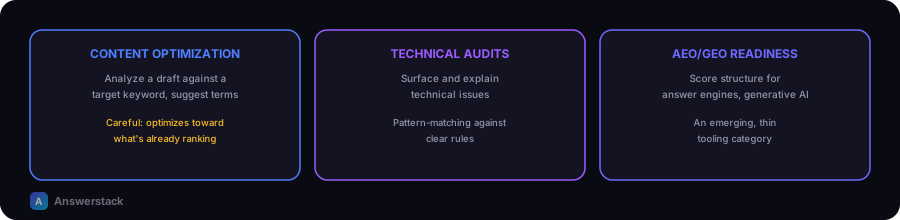
Category 1: Content optimization assistants
What they do: analyze a draft against a target keyword and suggest related terms, structure, and length benchmarks based on what's currently ranking, sometimes with AI-assisted drafting built in.
What to be careful of: these tools optimize toward what's already ranking, which can nudge content toward sounding like everything else already out there — genuinely useful information and original analysis still matter more than hitting a keyword-density target. Use suggestions as input, not as the definition of done.
Best fit: teams producing high content volume who want a structural sanity-check, used alongside — not instead of — genuine subject-matter expertise.
Category 2: AI-assisted technical audits
What they do: crawl a site and use AI to help prioritize or explain technical issues (which ones matter most, in plain language) on top of traditional crawl data.
What to be careful of: the underlying crawl data quality matters more than the AI layer on top of it — a good technical crawler with no AI summary is more useful than a weak crawler with an AI-generated explanation of incomplete data.
Best fit: teams that want technical SEO findings translated into prioritized, plain-language action items rather than a raw issue list.
Category 3: AEO/GEO readiness tools
What they do: analyze content structure, question coverage, entity clarity, and citation signals — the factors covered in What Is AEO? and What Is GEO? — and produce a readiness score.
What to be careful of: no tool in this category — including the free ones on this site — can guarantee a specific AI citation or ranking outcome. Treat scores as directional quality signals, not predictions. See How to Measure AI Search Visibility for a realistic view of what's actually measurable today.
Free examples on this site: the AEO Content Analyzer and GEO Readiness Checker are rule-based tools in this category — transparent heuristics, not black-box AI scoring, built specifically so you can see exactly what's being measured.
How to decide what you actually need
| Your situation | Start with |
|---|---|
| Struggling to structure articles consistently | Content optimization assistant |
| Suspect technical issues but don't know where to start | AI-assisted technical audit, or a free crawler + manual review |
| Want to prepare content for AI search specifically | AEO/GEO readiness tools + the structural practices in How to Structure Content for AI Search |
| Small site, limited budget | Free tools (this site's own tools, plus Search Console) cover the fundamentals before a paid tool adds much |
The honest bottom line
None of these categories replace the underlying work described elsewhere on this site — matching search intent, building genuine topical depth, and writing clearly. AI SEO tools are accelerants for that work, not substitutes for it. A tool that scores well on structure but says nothing new or useful still won't outperform genuinely useful content that's slightly less "optimized."