SEO (search engine optimization) is the practice of structuring, writing, and technically building a website so that search engines can crawl, understand, and rank it for the queries it's genuinely useful for.
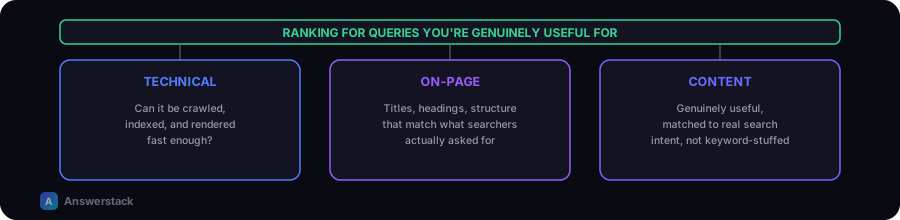
The three pillars of SEO
Nearly everything in SEO falls into one of three categories:
- Technical SEO — can search engines find, crawl, and render your pages correctly? Covers site speed, crawlability, indexing, mobile-friendliness, and structured data. See Technical SEO Explained.
- On-page SEO — does each page clearly signal what it's about and answer the query well? Covers titles, headings, content structure, and internal links. See How Internal Linking Works.
- Content strategy — are you writing about the right topics, matching real search intent, in a way that's genuinely more useful than what's already ranking? See Search Intent Explained.
A site can be perfect on one pillar and fail on another — fast, technically clean pages with thin content won't rank, and neither will excellent content buried behind crawl errors.
How search engines actually rank pages (simplified)
- Crawling — bots discover your pages via links and your sitemap.
- Indexing — the page's content is processed and stored so it can be retrieved for relevant queries.
- Ranking — for a given query, the engine scores indexed pages on relevance, quality signals (content depth, authority, user experience), and hundreds of other factors, then orders results.
Nothing here is a single trick — sites rank well by being genuinely the best available answer to a query and being technically accessible enough for that to be recognized.
What changed with AI search
Search behavior is splitting into two overlapping tracks:
- Traditional search — the classic ranked list of blue links, still governed by SEO fundamentals.
- AI-powered search and assistants — answer engines and AI assistants that synthesize an answer directly, sometimes citing sources. Optimizing for this is often called AEO (answer engine optimization) or GEO (generative engine optimization) — see SEO vs AEO vs GEO.
The good news: the fundamentals overlap heavily. Clear, well-structured, genuinely useful content that ranks well in traditional search is also the content most likely to get cited by AI systems.
A realistic first SEO checklist
- Every important page has a unique, descriptive title and meta description
- Site has a valid XML sitemap and robots.txt
- Pages load reasonably fast on mobile
- Content is organized into logical topic clusters with internal links between related pages
- No duplicate or thin (near-empty) pages competing with each other
- Google Search Console is connected so you can see real query and indexing data
Common misconceptions
- "SEO is about tricking Google." Modern SEO is about removing technical friction and being genuinely the best answer — manipulative tactics tend to get penalized or simply stop working.
- "More content is always better." Thin, repetitive content dilutes authority. A smaller number of comprehensive, well-linked pages usually outperforms a large number of shallow ones.
- "SEO is a one-time setup." Search behavior, competitors, and algorithms change continuously — see SEO Audit Checklist for a recurring review process.