AI genuinely speeds up the mechanical, pattern-following parts of SEO — auditing pages against a checklist, drafting meta descriptions, structuring content briefs — while judgment-heavy work (which keywords are actually worth targeting, what a page's real competitive angle should be) still needs a human making the call. "Automate SEO with AI" means automating the first category, not replacing the second.
For which specific tools handle this, see AI SEO Tools: What They Actually Do. This article is about which SEO tasks are actually good automation candidates.
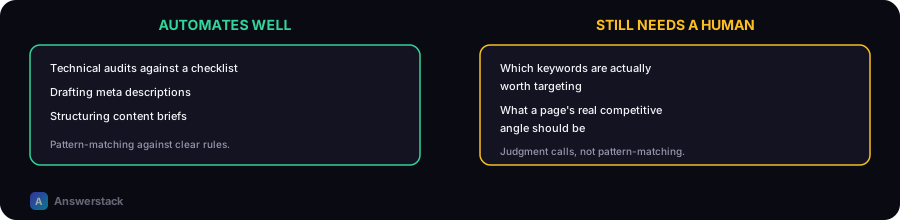
What automates well
Technical audits against a fixed checklist
Checking for missing meta descriptions, duplicate titles, broken internal links, missing alt text — these are pattern-matching tasks against clear rules, exactly what rule-based or AI-assisted tooling does reliably. See the SEO Audit Checklist for the underlying checklist this kind of automation runs against.
First-draft meta descriptions and titles
Generating a first-pass meta description or title variant from a page's content is a well-bounded task an AI tool handles reasonably well — with a human still reviewing before publishing, since a generic or slightly-off description hurts click-through rate.
Content brief structuring
Turning a target keyword and a set of "people also ask" questions into a structured outline (headings, subtopics to cover, questions to answer) is a genuinely useful automation — it doesn't decide whether the keyword is worth targeting, but it speeds up structuring the piece once you've decided.
Internal link suggestions
Surfacing which existing pages could reasonably link to a new page based on topic overlap is a good automation candidate — a human still decides which suggestions make sense, but generating the candidate list by hand across a large site doesn't scale.
What doesn't automate well (yet)
Keyword prioritization
Deciding which keywords are actually worth targeting requires business judgment — relevance to what you actually offer, realistic ranking opportunity, and value if you rank — that a tool can surface data for but shouldn't decide alone. See Keyword Research: A Practical Process for the human-judgment framework this still requires.
A page's competitive angle
What makes your page genuinely better or different from what's currently ranking is a strategic call, not a pattern-matching task. AI can summarize what's currently ranking; it can't reliably decide what unique value your page should add.
Full article generation without a real editorial pass
Fully AI-generated articles published without substantial human editing tend to be generic, occasionally wrong, and indistinguishable from a large volume of similar AI-generated content elsewhere — which works against both traditional ranking and AI-search citability (see How to Get Cited by AI Search Engines). Automating the drafting step is fine; skipping the editorial step is where this goes wrong.
A practical dividing line
Automate the step if getting it wrong is cheap to catch and fix (a slightly awkward meta description, a missed internal link suggestion). Keep a human in the loop if getting it wrong is expensive or hard to detect (publishing a wrong or generic article, targeting the wrong keyword for months before noticing it's not converting).