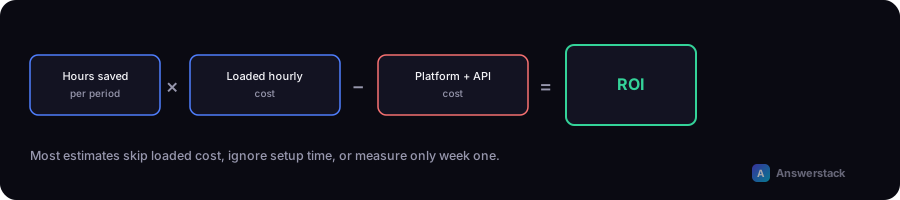
AI automation ROI is time saved (hours per week × loaded hourly cost of the person doing the work) minus ongoing cost (platform fees + API usage), measured over a fixed period — not a vague sense that "this should save time." Most rough estimates fail because they skip loaded cost, ignore setup time, or measure only in the first week before the process has stabilized.
Run your own numbers with the AI Automation ROI Calculator — this article covers how to get the inputs right, which is where most estimates actually go wrong.
The basic formula
ROI = (hours saved per period × loaded hourly cost) − (platform cost + API cost)
Each term has a common mistake attached to it:
| Term | Common mistake |
|---|---|
| Hours saved | Measured from a demo or best-case run, not real average performance including edge cases and exceptions |
| Loaded hourly cost | Using base salary only, ignoring benefits/overhead — understates true cost by 20-40% typically |
| Platform cost | Ignoring that per-task pricing scales with volume — a cost that looked negligible at pilot volume can be real at production volume |
| API cost | Estimating from a single short prompt, not realistic average input/output length across actual use |
Why "hours saved" is the hardest number to get right
The honest way to measure this is a parallel run: keep doing the process manually for a set period while the automation also runs, and compare actual time spent on the manual version against the time spent reviewing/correcting the automated version — not against a hypothetical "zero time" if everything worked perfectly. Automation rarely eliminates all human time; it usually shifts it from doing the work to reviewing it, especially early on with a human-in-the-loop checkpoint (see How to Build an AI Business Workflow). ROI should be calculated against that reduced-but-nonzero remaining time, not zero.
Loaded cost, not salary
Loaded hourly cost includes salary plus benefits, payroll tax, and overhead — commonly 1.25-1.4× base salary as a rough multiplier, though this varies by situation. Using base salary alone systematically understates the value of time saved, making genuinely good automation projects look weaker than they are on paper.
Don't forget setup time in the payback period
A process that saves 5 hours/week but took 40 hours to build and validate has a real payback period — divide setup hours by weekly hours saved to get weeks-to-payback, and use that number, not just the ongoing weekly savings, when deciding whether a project was worth it. A automation that pays back in 8 weeks and keeps saving time indefinitely afterward is a very different proposition than one that never quite gets past its setup cost, and both look identical if you only report "hours saved per week."
A worked example
Automating first-draft support replies, reviewed by a human before sending:
- Manual baseline: 12 minutes/ticket × 200 tickets/week = 40 hours/week
- With automation: 3 minutes/ticket to review + edit a draft × 200 tickets/week = 10 hours/week
- Hours saved: 30/week
- Loaded hourly cost: $35
- Weekly value: 30 × $35 = $1,050
- Platform + API cost: ~$80/week at this volume
- Weekly ROI: $1,050 − $80 = $970/week
- Setup time: 25 hours → payback in roughly 3.5 weeks of savings at this pace
When the honest answer is "not yet"
If projected hours saved barely exceeds platform/API cost, or the process is too low-volume for the setup time to pay back within a reasonable window, the honest conclusion is to wait — either for volume to grow or for a simpler, cheaper implementation path. Forcing ROI-negative automation live because it's already built is a common way automation projects quietly become a net cost center.