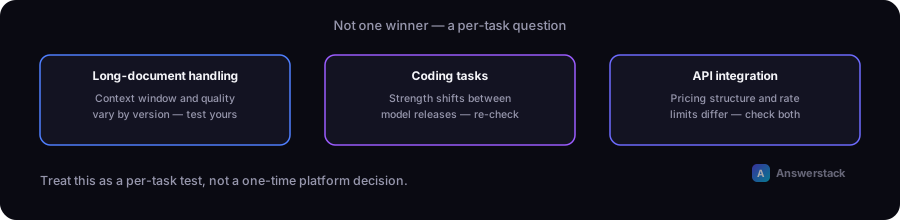
Neither ChatGPT nor Claude is universally "better" — both are strong general-purpose models from major providers (OpenAI and Anthropic), and the practical difference for a business shows up in specific task types, pricing structure, and how each integrates into a workflow, not in a single overall winner. Treat "which one" as a per-task question, not a one-time platform decision.
This is a practical-use framing, not a benchmark comparison — for the underlying decision framework (beyond just these two providers), see Choosing an AI Model Provider API.
Where the practical differences actually show up
| Factor | What to check for your use case |
|---|---|
| Long-document handling | Test both against your actual document length and complexity — context window and quality on long inputs vary by provider and model version |
| Coding/technical tasks | Test against your actual codebase and task type — general benchmarks don't reliably predict performance on your specific stack |
| Integration and API | Both have production APIs; compare actual latency, rate limits, and pricing at your volume (see Choosing an AI Model Provider API) |
| Consumer app features | If you're using the consumer chat app (not the API) for internal work, compare the specific features each app offers — file handling, memory, custom instructions |
| Data handling for business use | Check the business/team tier's data policy for both — consumer-tier terms often differ from business-tier terms |
Why "which is smarter" is the wrong question for a business decision
General intelligence benchmarks measure broad capability, not your specific task. A model that scores marginally higher on a general benchmark can perform worse on your actual use case — a specific document format, a particular coding pattern, a narrow domain — than one that scores lower overall. The right question is "which performs better on my actual task," answered by testing both against real examples from your work, not by reading a benchmark leaderboard.
A practical decision approach
- Define the specific task — not "which AI is best" but "which handles [drafting technical documentation / summarizing long contracts / writing code in our stack] better."
- Test both against 5-10 real examples from your actual work, not toy prompts.
- Check pricing at your expected volume if you're integrating via API rather than using the consumer app — costs can diverge meaningfully depending on typical input/output length for your task.
- Don't assume the decision is permanent — both providers update models regularly; a comparison that held six months ago may not hold today. Re-test periodically rather than treating this as a one-time choice.
When it doesn't matter which you pick
For a lot of everyday business writing and summarization tasks, both perform well enough that the difference is marginal — in these cases, pick based on which interface your team already prefers, or which one you're already paying for, rather than chasing a small capability edge that may not be reliable across all inputs anyway.