Traditional automation executes fixed rules on structured input (if X, then Y). AI automation adds a model that can interpret unstructured input and make context-dependent decisions. Most real systems use both — deterministic steps around one or two AI-powered steps.
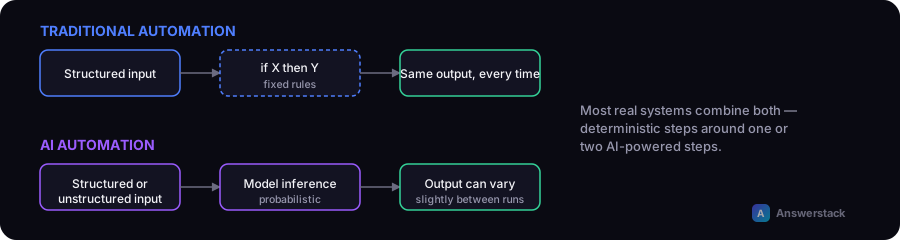
Side-by-side comparison
| Traditional automation | AI automation | |
|---|---|---|
| Input | Structured (forms, fixed fields, known formats) | Structured or unstructured (free text, documents, speech) |
| Logic | Fixed rules, if/else | Model inference, probabilistic |
| Output | Deterministic — same input, same output | Can vary slightly between runs |
| Cost model | Mostly fixed (tool subscription) | Usage-based (per API call/token, plus tooling) |
| Best for | High-volume, low-variance tasks | High-variance tasks needing judgment |
| Failure mode | Breaks or does nothing on unexpected input | Can produce a plausible-but-wrong output |
| Debuggability | Easy — trace the exact rule that fired | Harder — requires evaluating model behavior over many cases |
| Example tool | Zapier filter, spreadsheet macro, cron job | LLM classification/drafting step inside a workflow |
When traditional automation wins
- The input format is fixed and known in advance (a specific form, a specific API payload).
- The decision is genuinely binary or simple ("if amount > $500, require approval").
- You need guaranteed, repeatable output every time (financial calculations, compliance logic).
- Cost predictability matters more than flexibility.
Don't reach for AI here — it adds cost, latency, and a small error rate to a problem that a rule already solves perfectly.
When AI automation wins
- Input varies in wording, structure, or format (emails, support tickets, contracts, chat messages).
- The task requires understanding meaning, not matching a pattern (intent classification, sentiment, summarization).
- New variations appear often enough that maintaining rules becomes a full-time job.
- Some judgment or drafting is genuinely useful, even if a human reviews the result.
The hybrid pattern most production systems actually use
Almost no real system is 100% one or the other. A typical structure:
Trigger (deterministic)
   → Fetch/prepare data (deterministic)
   → AI step: classify / extract / draft (probabilistic)
   → Rule: confidence check, routing logic (deterministic)
   → Action: update record, send message, notify human (deterministic)
The AI step is isolated, testable on its own, and wrapped in deterministic guardrails on both sides. This is the pattern used in How to Build an AI Business Workflow.
A quick decision test
Ask: "Could I write a complete, exhaustive list of if/else rules that would handle every case I've seen in the last 3 months?"
- If yes → traditional automation is simpler, cheaper, and more reliable. Use it.
- If no, because inputs are too varied → that's a signal an AI step will earn its cost.
Common mistake
Teams often over-correct in one direction: either forcing AI into a task a simple rule handles fine (wasting money and adding unpredictability), or trying to write increasingly complex rule trees to handle natural-language input (a maintenance burden that AI classification solves more cleanly). Evaluate each step, not the whole workflow, against the test above.